
Understand Jefferson Davis County Deed Records
Deeds in Jefferson Davis County are recorded by the Chancery Clerk, the county's public recorder for land instruments. A deed names the grantor and grantee, states the interest conveyed, and describes the land affected. The label on the instrument only goes so far. What governs is the complete text, with its reservations, exceptions, signatures, acknowledgments, and recording information, because those details determine what the instrument truly says about the property.
| Deed Type | What It Does | Typical Record Question |
|---|---|---|
| Warranty deed | Conveys the stated interest with warranties written in the instrument | What assurances accompanied an ordinary transfer? |
| Quitclaim deed | Conveys whatever interest the grantor holds, without creating broader assurances | Was a possible interest released or corrected? |
| Trustee or fiduciary deed | Conveys in a stated representative capacity | What authority supported the transfer? |
| Executor or estate deed | Transfers through estate administration | Which probate order or authority applies? |
| Tax-related deed | Records an instrument arising from a delinquent-tax process | Were redemption and title issues resolved? |
Other instruments share the deed books. Mortgages, deeds of trust, releases, assignments, liens, lis pendens, easements, restrictions, and plats may appear alongside deeds in Jefferson Davis County property records, yet each one answers a different question about the land. An encumbrance never transfers ownership by itself.
Use the Chancery Clerk as the Recorded-Land Gateway
The Jefferson Davis County Chancery Clerk records deeds, mortgages and deeds of trust, construction and condominium liens, federal tax liens, lis pendens, military discharges, plats, and other land instruments. The same office serves Chancery Court. Estate, land-title, contract, guardianship, and property matters filed there may add a separate court file to your deed search. The county publishes no verified online deed index, image-fee schedule, or bulk download. Do not treat the parcel viewer as a deed index. Use it only to collect an owner spelling, a parcel number, deed and plat references, and legal-description clues for the official search at the clerk's counter or by phone.
Walk the Jefferson Davis Grantor-Grantee Chain
A deed chain comes together one indexed party and one legal description at a time. Start from the newest reliable deed lead you hold. Then move backward through the Jefferson Davis County land index deliberately, confirming each link before reaching for the next.
- Find the present owner's acquisition instrument, searching that owner as grantee.
- Read the instrument and identify its grantor, recording reference, date, and complete legal description.
- Search that grantor as an earlier grantee to locate the prior acquisition.
- Compare each description, parcel split, reservation, and prior-instrument reference before joining the links.
- Repeat until the research period is reached, then move to physical books, microfilm, and predecessor-county sources where necessary.
- Grantor
- The party conveying the interest stated in an instrument.
- Grantee
- The party receiving that stated interest.
- Chain of title
- The connected sequence of conveyances and other title-affecting records for the same land.
- Book and page
- A volume-and-page reference used to retrieve a recorded item.
- Instrument number
- A unique recording identifier where that indexing method is used.
Note: A shared surname alone is not a chain link, since the legal description and recording references must also agree.
Prepare the Fields for an Offline Deed Search
Jefferson Davis County publishes no online deed index. That makes a precise request the fastest route at the counter or by phone. Give the clerk several keys, not just a modern parcel number, so the property search has room to work.
| Search Key | Useful Form | Why It Helps |
|---|---|---|
| Parties | Grantor, grantee, estate, trustee, or exact entity name | Locates indexed names and variants |
| Recording clue | Date range, book/page, instrument number, or deed reference | Narrows retrieval |
| Land | Subdivision, lot/block, section-township-range, acreage, or metes and bounds | Separates same-name parties and similarly numbered parcels |
| Map crosswalk | PARNO, PPIN, CAMA, tax map, or plat reference | Connects current assessment data to older land records |
| Document request | Instrument type, ordinary or certified copy, and delivery method | Lets staff estimate cost and handling |
Older deeds can predate current addresses and parcel identifiers. When an address-only request fails, try former road names, owner name variants, and the controlling legal description instead.
Follow the Legal Description, Not Just PARNO
The state parcel schema exposes DEEDREF, DEEDDATE, PLATREF, PLATDATE, and LEGLDESC. It also holds tax map, section, township, range, and subdivision fields. Treat these as leads only. The layer's own description warns that originating data can omit some deed, plat, zoning, subdivision, and legal-description values. A single deed can convey several assessment parcels or just part of one. A current polygon may also be the successor to a split or a merge. Read lot and block, plat book and page, and quarter sections. Check metes-and-bounds calls, monuments, roads, streams, and easements. Look for rights-of-way, mineral or timber reservations, exceptions, and prior references. A blank GIS field never proves that no recorded instrument exists.
Bridge the 1906 County-Formation Divide
Jefferson Davis County was created in 1906. That date sets an important boundary for a deed-records search. County records can begin with the new jurisdiction. An earlier chain may continue in predecessor-county books or in state and federal land records. The county supplies no confirmed first deed book or earliest searchable year. The MDAH Jefferson Davis County series catalogs assessment and record material from 1906 through 1931. That helps bridge the divide.
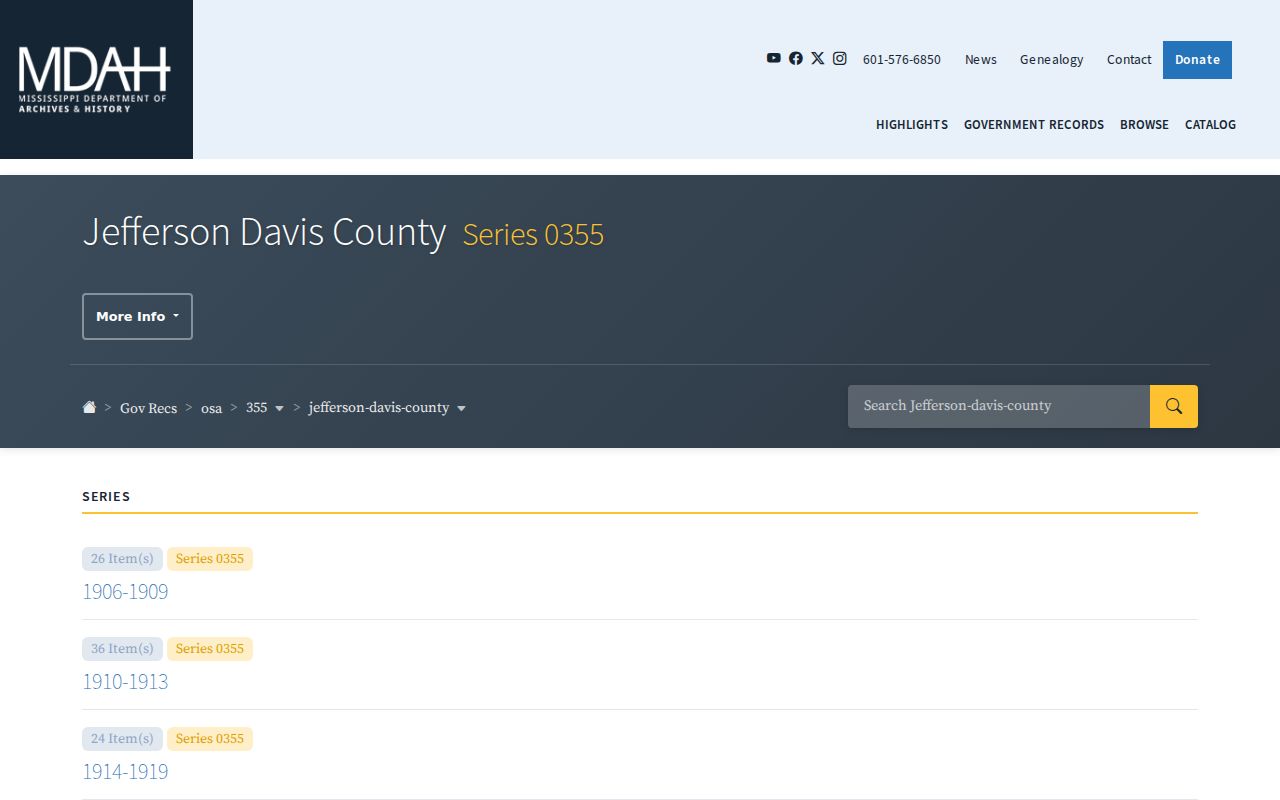
The catalog offers an archival route and year groupings. It cannot replace reading the requested deed or building a complete chain from the recorder's own books.
Request Older Jefferson Davis Records on Microfilm
The MDAH county-records microfilm index lets researchers select Jefferson Davis County and identify available county material on film.
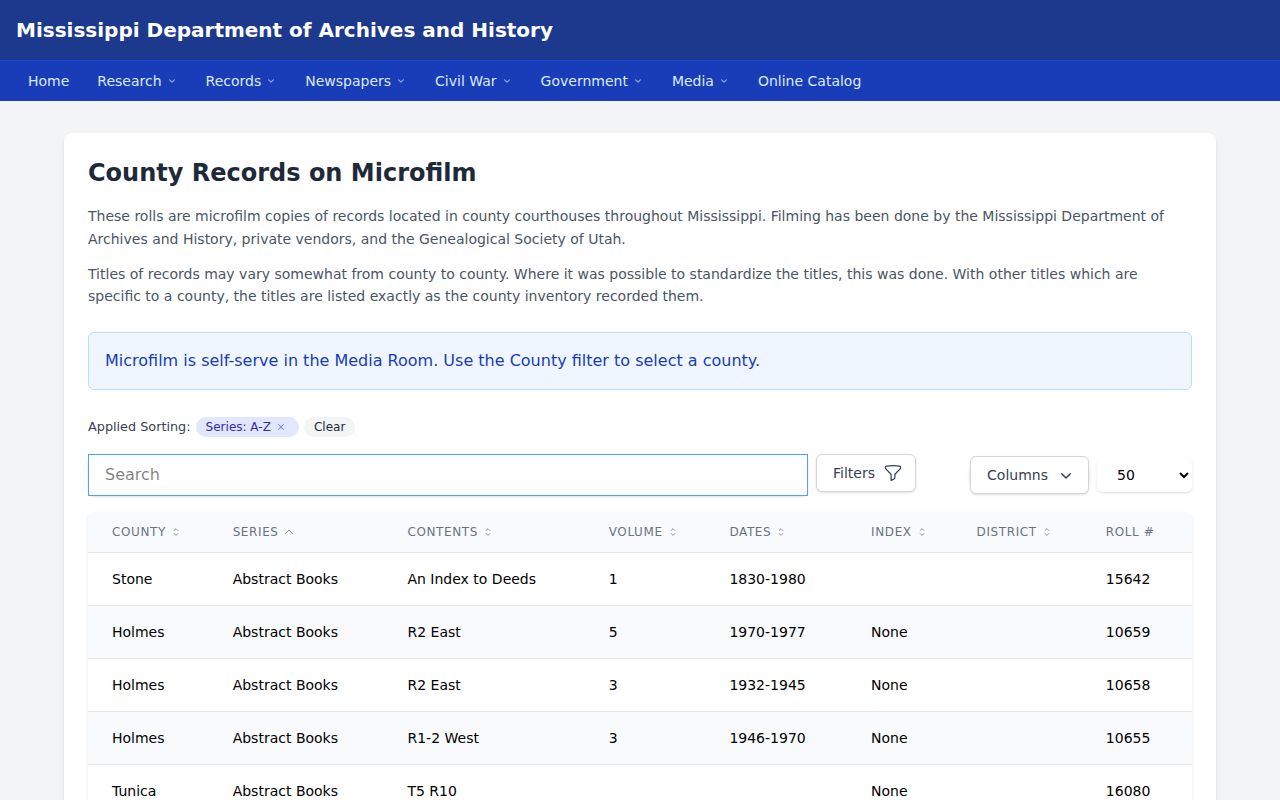
The index helps locate film. It does not finish the job. Preserve the film, volume, box, page, and repository citations. Then compare the image with the clerk's record. MDAH's research services and reading room offer another access channel. This helps when a courthouse trip is impractical. Ask the Chancery Clerk which deed books remain at the courthouse and which are filmed. Ask whether an appointment is needed and whether copies can be mailed or delivered electronically. The county has supplied no imaging cutover year, so do not assume one.
Use the Mississippi Wills and Deeds Collection as a Lead
The FamilySearch Mississippi Wills and Deeds collection draws on material from multiple county custodians. It can extend a name or place search for Jefferson Davis County deed records beyond local books.
The collection's landing page shows the route, while account and image restrictions may apply. Treat indexed names as finding aids. Inspect the original image when available, and verify the citation with the courthouse or archive. Probate records matter too. An executor, administrator, guardian, heir, or estate conveyance can break an otherwise simple grantor-grantee sequence.
Order a Jefferson Davis County Deed Copy
Start with the Chancery Clerk at 601-792-4204, fax 601-792-2894, or P.O. Box 1137, Prentiss, MS 39474. Ask which request routes the office allows. Phone-assisted lookups, mailed requests, and in-person index searches may each carry different rules. Give the parties, an approximate recording date, and the land description. Add any recording reference you hold. Say plainly whether you need an ordinary research copy or a certified copy.
Mississippi Code § 25-7-9 is the fee statute to verify with the clerk. The schedule cited there sets $25 for the first five recording pages. It adds $1 per additional page, with separate copy and certification items. Those are recording-schedule figures, not a quoted price for your copy. Confirm current charges before sending money. Ask about electronic delivery, postage, accepted payment methods, special instrument fees, and expected turnaround.
For a counter visit, bring a worksheet. It should list every spelling variant. It should also leave room to log index volume, deed book, page, instrument type, recording date, and cross-references. Ask staff whether direct and reverse indexes exist separately for your period. Ask whether older books rely on initials or handwritten variants. Photograph or transcribe the index citation before pulling an image. An image stripped of its source reference is hard to verify later.
A mailed request works best when it names a narrow date range. Explain whether staff should search one named party or follow a referenced instrument. Include contact details. The clerk can then resolve a mismatch rather than return an unrelated record. Never send an assumed fee. Confirm the total and the accepted payment method first.
If routine access stalls, the Mississippi Public Records Act opens an inspection and copying route. It remains subject to exemptions and reasonable procedures. An office may estimate its actual search, labor, copy, and delivery costs.
Know What a Recorded Deed Does Not Settle
A recorded deed shows what entered the public land records. It proves nothing more on its own. Prior conveyances, liens, releases, probate orders, tax-sale steps, boundary disputes, and unrecorded interests can all still lurk behind the page. A deed image is not a survey either. No GIS polygon becomes a legal boundary just because it looks tidy on a map.
Recorded is not guaranteed. Jefferson Davis County deed records are evidence, not a title opinion. Review the connected instruments and obtain qualified help when clear title or a boundary decision matters.
Keep an audit trail as you work. List every name variant, index period, volume, page, instrument, legal-description change, missing image, and office response. That discipline makes a gap visible instead of letting an assumption quietly bridge it.