
Jefferson Davis Ownership Timeline
Every ownership history starts with a dated sequence. The newest deed names a grantee and a grantor. The grantee is the party receiving the land. The grantor is the party giving it up. That grantor becomes your next previous owner to trace. Repeat the step until the chain reaches the county's formation, an index gap, or a deed whose prior reference points somewhere else entirely. Jefferson Davis County's Chancery Clerk keeps the deeds, mortgages, easements, restrictions, plats, liens, and other land instruments. The office publishes no working online grantor-grantee index and states no exact digital start year. That makes the counter route essential for this kind of property search.
| Record stage | Verified time frame | Custodian | Ownership clue |
|---|---|---|---|
| Current recorded deed | Current coverage, exact web span unverified | Chancery Clerk | Grantor, grantee, date, legal description, prior reference |
| County deed books and indexes | County context begins in 1906 | Chancery Clerk | Earlier transfers by name and book/page |
| MDAH county series | Catalog groups from 1906 through 1931 | Mississippi Department of Archives and History | Historic assessment and record context, not a complete deed chain |
| Predecessor-county material | Before 1906 when the land history requires it | Relevant county clerk or archive | Transfers made before Jefferson Davis County existed |
Always work from the newest reliable deed reference. A parcel layer may expose DEEDREF and DEEDDATE fields. Either one can sit blank or stale, though. Confirm the lead with the Chancery Clerk before extending the chain any further back. For early material, treat archive catalog dates as descriptions of what a repository holds. Never treat them as proof that every index or image survived.
Reconstruct Jefferson Davis Prior Owners
A sound timeline gives each transfer its own row. Never jump from a modern owner to an old surname. Do not assume a link just because both names appear near the same road. Match the legal description instead. Acreage, adjoining-owner calls, subdivision and lot, or section-township-range must line up before two records describe one ownership line. Parcel identifiers can change after a split or a merge. The number alone is a weak anchor. One deed may cover several tax parcels. One tax parcel may hold only part of a larger deed description.
| Transfer date | Grantor to grantee | Instrument | Reference to preserve |
|---|---|---|---|
| Newest verified date | Seller to present grantee | Warranty, quitclaim, probate, or other deed | Instrument number or book/page |
| Prior verified date | Earlier grantor to later seller | Instrument named in the index | Legal description and prior reference |
| Earlier interval | Repeat only after parcel match | Deed, decree, estate order, or correction | Repository, volume, page, and image status |
The blank table is deliberate. Jefferson Davis County publishes no sample deed-index row online. Fill each row only from a record you retrieve yourself, never from invented names, prices, book numbers, or transfer dates.
County Formation Changes the Search
Jefferson Davis County formed in 1906. That date is a practical break in former-owner research. A parcel may have existed long before the county did, and its earlier deeds may sit filed under a predecessor county. The earliest surviving local volume is not confirmed. Ask the Chancery Clerk which local books survive, which were microfilmed, and which older jurisdiction holds the land records for the parcel at issue.
Name changes create a second break. Marriage, estates, trusts, corporate mergers, initials, and spelling shifts can all alter the indexed party. Search each verified form of a name. Keep the date range and instrument type with every entry. Then demand the same legal description before treating two entries as one ownership line.
Note: County formation marks an index boundary, not proof that the property's history began in 1906.
Walk Jefferson Davis Deeds Backward
The backward method tracks roles, dates, and land descriptions together. A reverse index generally lists deeds by grantee. A direct index generally lists them by grantor. The Clerk's exact index labels and terminal fields are not published online, so ask the office how its books separate the two sides before you commit a deed record to either column.
- Locate the newest confirmed deed for the subject legal description. Record its grantee, grantor, execution and recording dates, deed type, and prior reference.
- Treat the grantor as the next prior-owner candidate. Search that name as a grantee during an earlier date range.
- Open the earlier instrument. Confirm the same land, then capture its grantor and all cross-references.
- Repeat until the chain reaches an archive boundary. Continue through deed books, microfilm, court files, or predecessor-county indexes as needed.
- Grantor and grantee
- The conveying party and receiving party named in an instrument.
- Chain of title
- The ordered series of instruments that transferred an interest in the same land.
- Reverse index
- An index arranged by grantee, useful for finding how a former owner acquired land.
- Quitclaim and warranty deed
- A quitclaim conveys the grantor's interest without the same warranties commonly stated in a warranty deed.
Jefferson Davis Estate Transfers
A clean sale-to-sale chain can break when an owner dies. Chancery Court handles estates, probate, heirship, guardianships, conservatorships, and related land matters. Search the decedent's name, alternate spellings, executor or administrator, heirs, and the parcel's legal description. Useful items range from a will and its admitting order to letters, inventory, sale order, heirship order, distribution, and the later deed out of the estate. The name on a probate order may differ from the later grantee name. An estate, trust, or representative can appear between individuals. Record the authority behind each transfer. Never infer an heir's title from an obituary or family relationship alone.
Historic Jefferson Davis Record Paths
The MDAH Jefferson Davis series gathers material spanning 1906 to 1931. Its catalog can narrow an archive request, but it does not establish a continuous run of deeds.
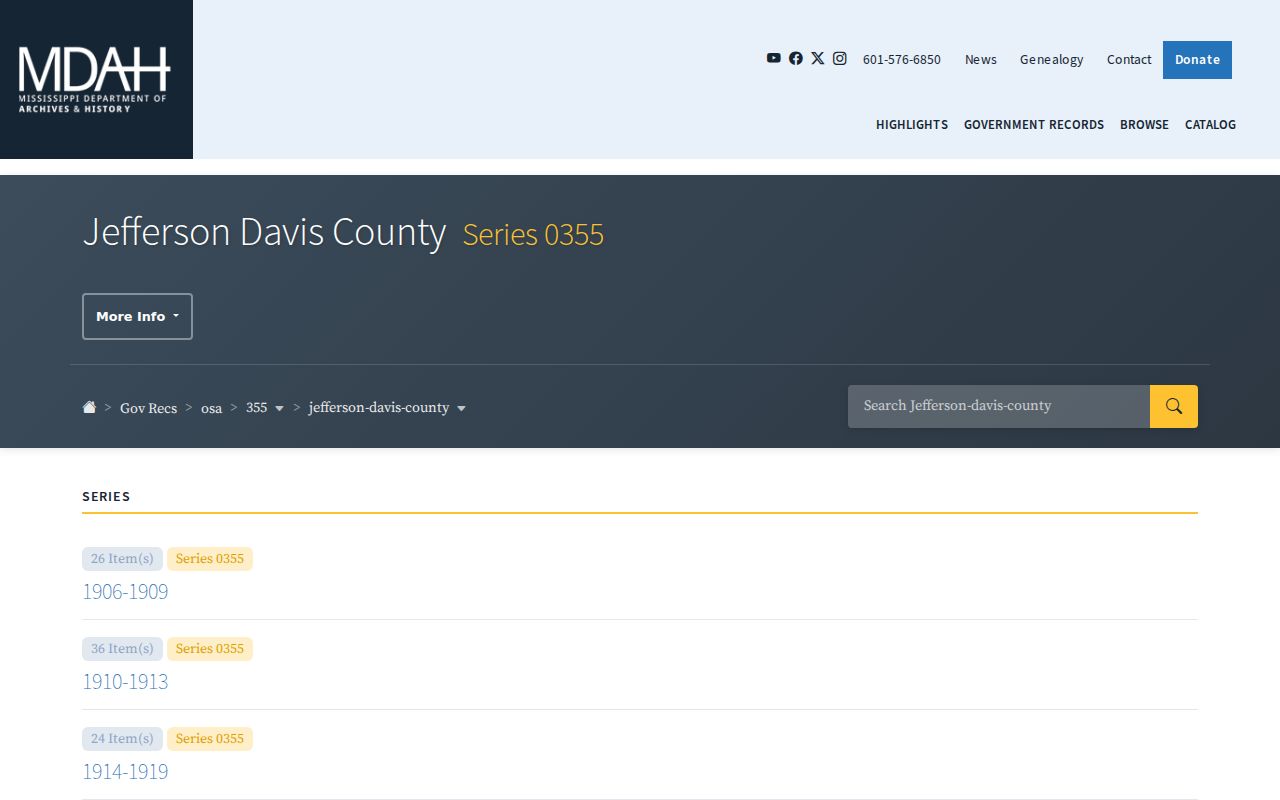
The MDAH catalog page displays series and item metadata. Cite that metadata, then ask whether the underlying record is online, on microfilm, or available only in a reading room. The MDAH county microfilm catalog offers county and series filters for another route into older records.
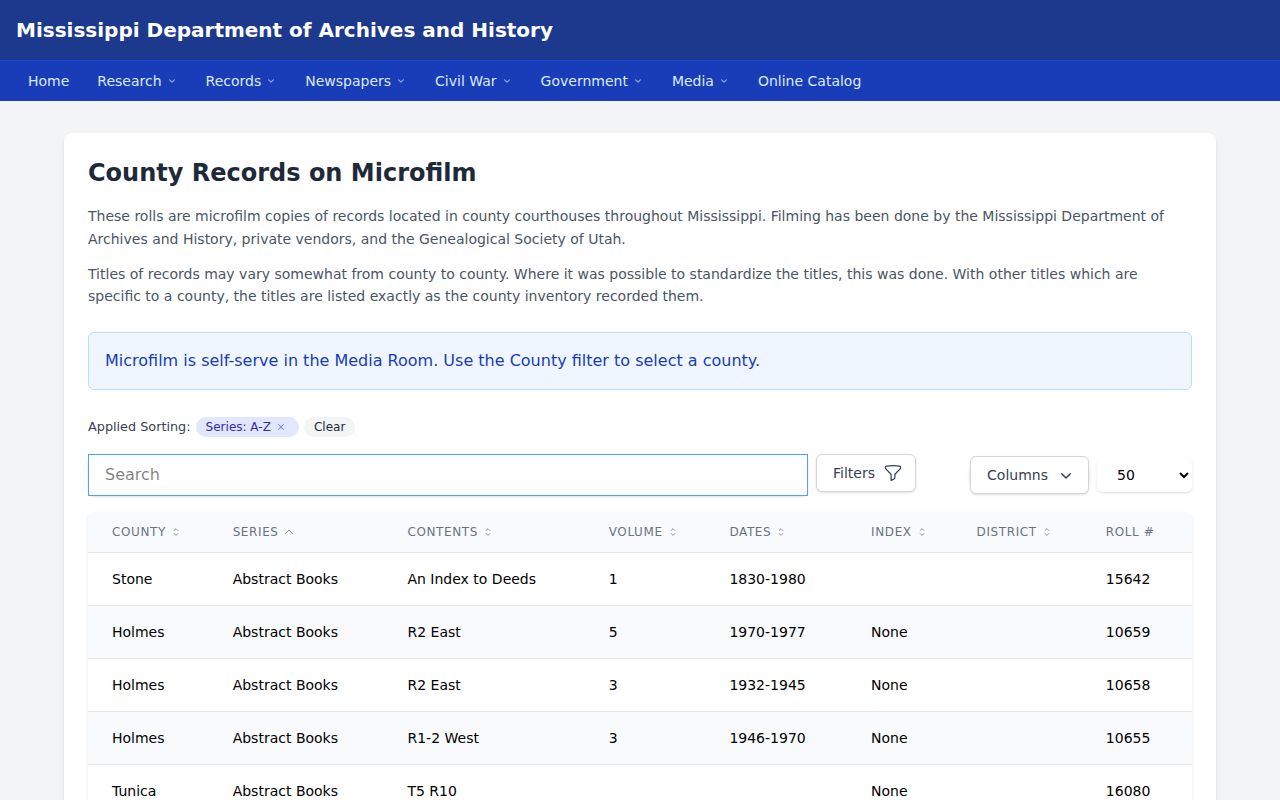
Microfilm may preserve an index or book that county web pages do not show. Ask for exact reel, volume, year, and page coverage before any visit. A separate Mississippi wills and deeds collection opens another discovery route. Image access there may require an account. It may also carry viewing restrictions.
Collection-wide dates never guarantee Jefferson Davis County coverage. Verify each image against its original county, book, and page.
Request Former Owner Records
If the online index comes up empty, the Jefferson Davis County Chancery Clerk can still help by counter, phone, or mail. Give staff what you already have: the current owner of record, any prior names, the parcel address, the full legal description, a date range, the deed type, and any instrument or book and page reference. The office lists P.O. Box 1137, Prentiss, Mississippi 39474 and 601-792-4204.
A few questions are worth asking. Can staff search by name? Is there a public terminal? How are the older deed books stored, and can copies go out electronically? Mississippi Code section 25-7-9 sets the recording fees, and a cited recording schedule applies, but confirm copy and certification charges before paying. Certified copies are not always necessary. Save plain copies while you work, then order certification only if your final use demands it.
Jefferson Davis Ownership Gaps
Jefferson Davis County publishes no coverage chart online. No cutoff date or sample index entry appears either. That is an access gap, not proof that prior owners are unknowable. Record the last transfer you confirmed, the repository used, the names and dates searched, and each response received. Local series often end at county formation. Continue with the predecessor jurisdiction the Clerk identifies.
If an image is missing or illegible, request the original book or alternate microfilm. Do not rebuild text from context. Side sources help. Historic tax rolls, plats, maps, directories, newspapers, church records, and obituaries can support identity or place research, yet only the conveying instrument transfers title. County libraries collect local-history material, though no specific directory years are published, so ask the Prentiss and Bassfield branches for a written holdings response before relying on them.
Lawful use. Former-owner research supports house history, estate work, and property diligence. Never use ownership records to track, target, or harass a living person.